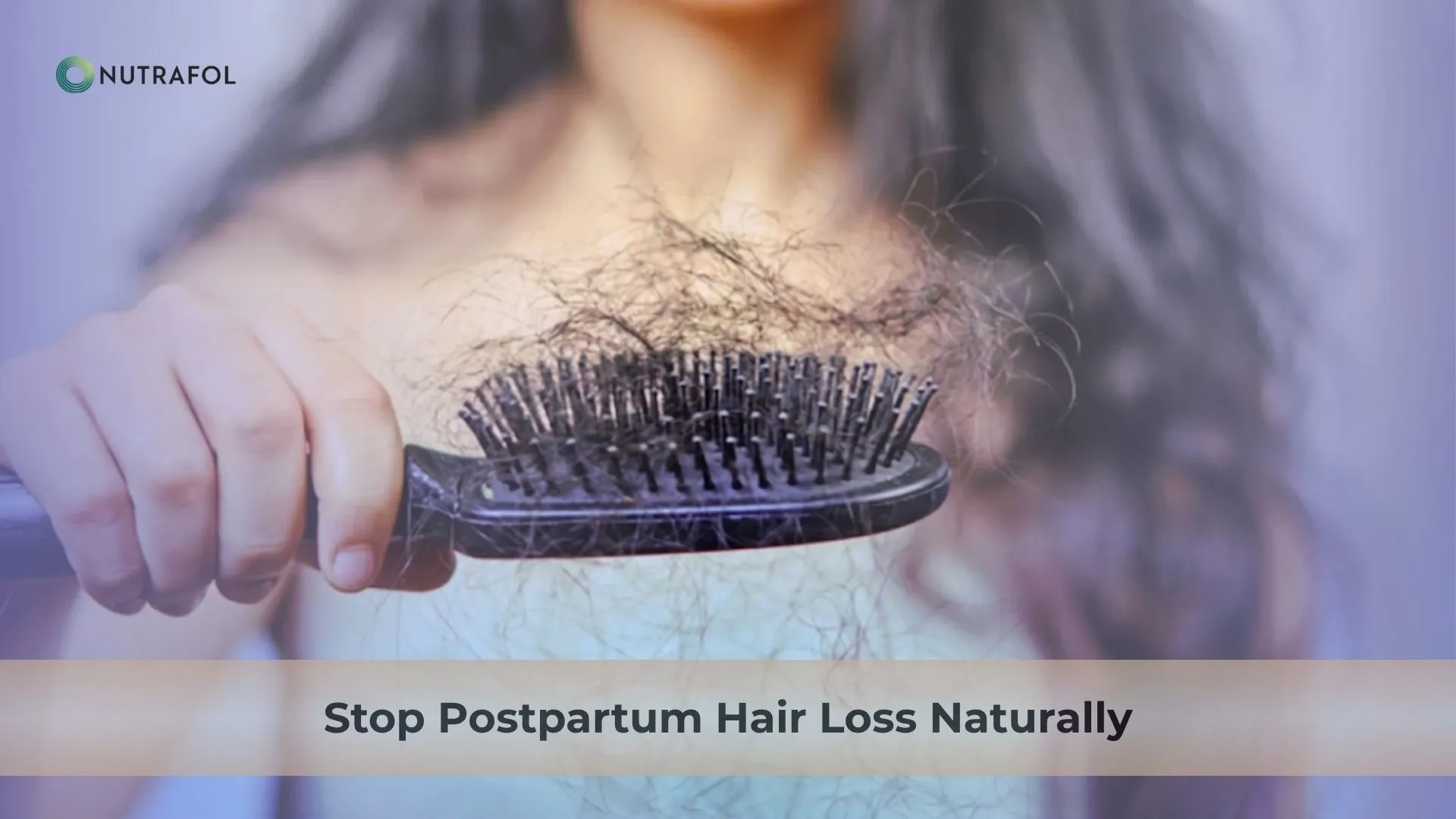
Most new parents notice it in the shower drain first. The strands you were shedding at a fraction of the usual rate during pregnancy suddenly arrive all at once, and the clumps feel alarming even when you know the mechanism behind them. The reassuring part is that the postpartum hair loss timeline is remarkably predictable, and knowing where you sit on it changes how you respond.
This is not pattern thinning. Postpartum shedding is acute telogen effluvium, a synchronized release of hair follicles that were held in place by pregnancy hormones. It has a start point, a peak, and an end point. What you do during that window influences how densely your hair returns.
What Actually Triggers Shedding After Birth
The Estrogen Drop and Your Hair Growth Cycle
During pregnancy, elevated estrogen extends the anagen (growth) phase. Follicles that would normally have cycled into rest simply keep going, which is why hair often looks thicker at 30 weeks than it ever has. After delivery, estrogen falls sharply within 24 to 48 hours. Those retained follicles receive the exit signal all at once and move into telogen together.
Telogen lasts roughly two to three months before the follicle releases the strand. This delay is the single most misunderstood part of hair loss after birth. The shedding you see is not happening now. It is the echo of a hormonal shift that occurred weeks earlier.
Why Telogen Effluvium Peaks Around 4 Months Postpartum
Do the math on that lag and the timing makes sense. Hormonal collapse at delivery plus a 10 to 12 week telogen phase places peak shedding at roughly 3 to 4 months postpartum. Trichologists see this cluster so consistently that a client arriving at exactly 4 months postpartum with handfuls of hair rarely needs extensive workup. The pattern is diffuse, affects the whole scalp rather than a single crown or part line, and the hairs released have a visible white bulb at the root.
The Postpartum Hair Loss Timeline, Month by Month
Weeks 1 to 8: The Quiet Phase
Hair typically looks fine. Follicles are silently transitioning, but nothing is falling yet. This is the ideal window to establish nutrient reserves, because postpartum nutrient depletion compounds quickly with breastfeeding, blood loss at delivery, and interrupted sleep.
Months 3 to 5: Peak Shedding
Daily hair fall can jump from a baseline of 50 to 100 strands to 300 or more. Temples and the frontal hairline often thin most visibly because those follicles are more hormonally sensitive. Ponytail circumference shrinks. Scalp visibility increases under direct light.
This phase is distressing but self-limiting. Shedding volume typically holds steady for four to eight weeks, then begins tapering.
Months 6 to 12: Regrowth and Recovery
By month six, most people see shedding drop back toward baseline. Density recovery lags behind, because a follicle re-entering anagen grows at roughly half an inch per month. Full visual restoration commonly lands between 9 and 15 months postpartum.
If you want a deeper breakdown of how supplementation timing interacts with each growth phase, our hair wellness blog covers cycle-specific strategies in detail.
How to Recognize New Growth Versus Continued Loss
Look for short, wispy baby hairs standing upright along the hairline and part. These regrowth halos are the clearest sign your follicles have re-entered anagen. They frizz and refuse to lie flat, which is annoying and also excellent news.
When Postpartum Shedding Is No Longer "Normal"
Nutrient Depletion, Thyroid Shifts, and Iron Status
If shedding continues past 12 months, something beyond the hormonal reset is likely driving it. The most common contributors are low ferritin, which is extremely common after delivery, and postpartum thyroiditis, which affects a meaningful percentage of new mothers and often goes undiagnosed. Vitamin D insufficiency and low zinc also show up frequently in hair-focused bloodwork.
Chronic telogen effluvium can also develop when a temporary trigger overlaps with ongoing physiological stress. Sleep deprivation alone is enough to keep cortisol elevated for months.
Signs It Is Time to See a Dermatologist or Trichologist
Seek evaluation if you notice widening at the part line rather than diffuse thinning, patchy bald spots, scalp burning or tenderness, or shedding that continues unchanged past the 12-month mark. Ask for ferritin, TSH with free T4, vitamin D, and a complete blood count.
Supporting Recovery From the Inside Out
Stress, Cortisol, and the Fourth Trimester
Cortisol directly shortens anagen and pushes follicles toward premature rest. This is why postpartum stress management is a hair intervention, not just a wellness nicety. Adaptogenic support such as ashwagandha, which appears in Nutrafol's formulations, targets this pathway rather than simply adding more raw nutrients on top of a stressed system.
Practical measures matter here too. Protected sleep blocks, protein at every meal, and delegating night feeds where possible all lower the physiological load that keeps follicles in telogen.
Gut Health and Ingredient Absorption
You can take an excellent supplement and absorb very little of it. Postpartum gut motility changes, iron supplementation, and antibiotic exposure during delivery all affect the microbiome that governs nutrient uptake. Fat-soluble ingredients and botanical extracts absorb substantially better when taken with a meal containing dietary fat rather than on an empty stomach.
This is where hydrolyzed marine collagen and bioavailable curcumin formats earn their place. Particle size and delivery form determine how much of the label dose actually reaches your follicles.
Why Dosage Consistency Matters More Than Dose Size
Hair follicles respond to sustained nutrient availability, not spikes. Taking four capsules daily for three weeks and then stopping produces worse outcomes than steady daily intake across six months. Follicle cycles are measured in months, so evaluation windows should be too. Most clinical improvement in supplement studies appears between months three and six.
Set a fixed anchor: same meal, same time, every day. Pair it with an existing habit like the morning feed.
Want to optimize your hair regrowth journey for faster results? Start your Nutrafol routine and get a dosage plan matched to your postpartum stage.
Building a Long-Term Hair Wellness Plan
Postpartum recovery is a reasonable entry point into a longer strategy, not a one-off fix. Hormonal balance continues shifting through weaning, cycle return, and any subsequent pregnancy. A plan that accounts for hormonal transitions, ongoing stress adaptation, protein and iron intake, and scalp circulation will hold up better than a three-month supplement sprint.
Track progress with monthly photos taken in identical lighting rather than daily shed counts, which fluctuate too much to be useful.
Conclusion
Postpartum hair loss starts around month three, peaks near month four, and typically resolves by month twelve. That window is biologically driven and largely non-negotiable, but density outcome at the far end is not. Nutrient status, cortisol load, absorption capacity, and supplement consistency all shape how fully your follicles repopulate. Treat the recovery period as an active phase rather than a waiting one.
Frequently Asked Questions
Is postpartum shedding preventable?
Not entirely, since it is driven by an unavoidable estrogen drop. Strong
nutrient reserves and low inflammation before and during pregnancy can reduce
severity and shorten the recovery tail.
Can I take
hair supplements while breastfeeding?
Nutrafol produces a formulation
specifically designed for postpartum and breastfeeding use. Always confirm with
your OB or pediatrician before starting any supplement while nursing.
Why is my
hair loss worse at 4 months postpartum than at 2 months?
Because telogen lasts roughly two to
three months. The hormonal trigger happened at delivery, but the physical
shedding surfaces about 12 weeks later, which is why 4 months postpartum is the
common peak.
How long
until I see regrowth with a supplement?
Reduced shedding often appears
first, around months two to three. Visible density changes typically require
three to six months of consistent daily use because of how slowly follicles
cycle.
Will my
hair return to exactly its pre-pregnancy texture?
Often, though not always. Some
people notice a permanent shift in curl pattern or coarseness due to hormonal
changes affecting follicle shape. Density usually recovers even when texture
changes persist.