Hair thinning in men is rarely a random event. In clinical trichology, the vast majority of male shedding and receding temple lines stem from a specific androgenic hormone known as dihydrotestosterone. Understanding what is DHT hair loss requires looking closely at your scalp biochemistry, genetic receptor sensitivity, and cellular follicle dynamics rather than relying on generic grooming advice or surface-level shampoos.
Dihydrotestosterone is an active androgen derived from circulating testosterone. While vital for developing male characteristics during puberty, elevated localized sensitivity to dihydrotestosterone on the scalp creates significant challenges for mature hair follicles. When unbound androgens interact with susceptible hair roots, they trigger progressive follicle constriction that leads directly to androgenic alopecia, commonly known as male pattern baldness. Halting this biological cascade requires a targeted, science-backed approach that protects hair roots while nourishing the entire scalp ecosystem.
Understanding Dihydrotestosterone and Scalp Biology
To understand why hair sheds prematurely, one must examine how hormones behave within the scalp microenvironment. The human scalp contains roughly one hundred thousand hair follicles, each functioning as a distinct mini-organ governed by complex hormonal, vascular, and metabolic signals.
The Biological Mechanism: 5-Alpha Reductase and Testosterone Conversion
The formation of dihydrotestosterone occurs when free testosterone encounters an intracellular enzyme called 5-alpha reductase (5-AR). Concentrated within sebaceous glands and follicle sheaths, 5-AR converts normal testosterone into DHT, a significantly more potent androgen with high binding affinity for androgen receptors. When DHT binds to receptors within the dermal papilla, it alters cellular transcription factors, downregulates essential hair growth factors, and impairs localized vascular microcirculation.
Why Certain Follicles Are Genetically Vulnerable
Not all hair follicles respond to dihydrotestosterone in the same way. The hair follicles located across the temples, hairline, and crown exhibit high densities of androgen receptors and elevated local 5-AR activity due to hereditary predisposition. Conversely, follicles on the back and sides of the head generally lack these sensitive receptors, which explains why men retain their donor zones even during advanced male pattern baldness. Genetic sensitivity determines the rate and severity of follicle miniaturization rather than total blood testosterone levels alone.
How DHT Induces Progressive Hair Follicle Miniaturization
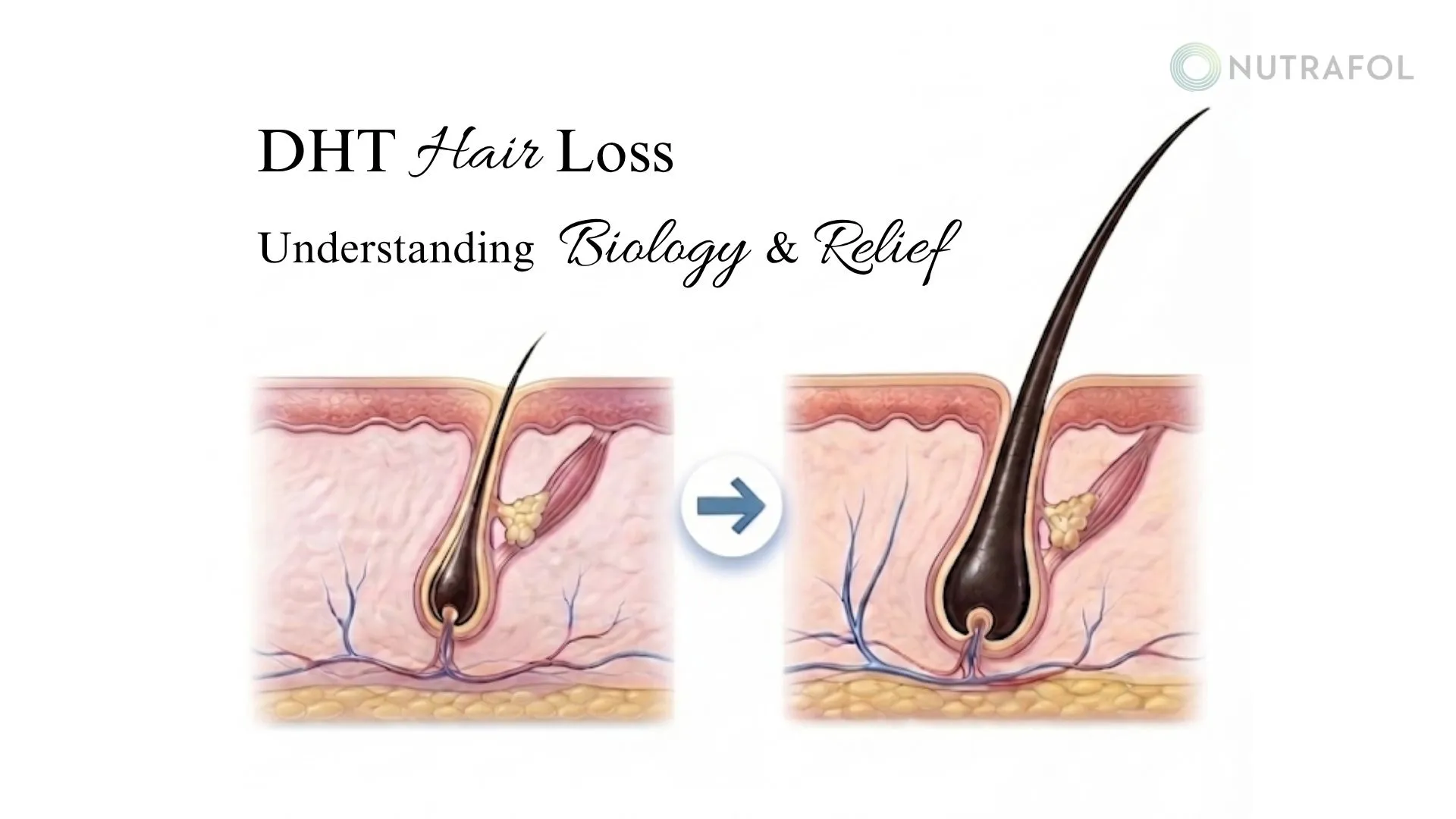
The hallmark of DHT scalp damage is hair follicle miniaturization. Under sustained androgenic stimulation, vulnerable follicles undergo morphological changes that weaken strand integrity and alter growth cycles over successive seasons.
Disrupting the Anagen Growth Phase
A normal, healthy hair follicle remains in the active growth phase, known as the anagen phase, for two to six years before cycling through brief transitional (catagen) and resting (telogen) phases. Dihydrotestosterone drastically shortens the duration of the anagen phase while extending the telogen phase. As each subsequent hair growth cycle becomes progressively shorter, the hair bulb produces thinner, shorter, and less pigmented strands, eventually replacing robust terminal hairs with fragile vellus fibers.
Dermal Papilla Receptor Binding and Nutrient Deprivation
When DHT binds to dermal papilla receptors, it stimulates the release of transforming growth factor-beta (TGF-beta) and interleukin-6, two pro-inflammatory signaling proteins. These inflammatory mediators induce perifollicular fibrosis, creating stiff, collagenous scar-like tissue around the hair root. This constriction restricts microvascular blood flow, starving the dermal papilla of vital amino acids, zinc, and micronutrients necessary for robust keratin synthesis.
Recognizing Early Signs of DHT-Driven Thinning in Men
Identifying androgenic shedding early provides the greatest opportunity to preserve follicle viability and restore natural strand density. The physical manifestations of DHT sensitivity typically follow predictable clinical patterns:
Receding Hairline and Temple Thinning: Gradual loss of hair density at the frontotemporal angles, creating the classic M-shaped hairline.
Vertex Thinning and Crown Loss: Widening circular shedding at the crown of the head where androgen receptor concentrations remain elevated.
Change in Strand Texture: Thick, pigmented terminal hairs become noticeably finer, softer, and more brittle before falling out.
Increased Daily Shedding: Noticeable strand accumulation on pillows, in shower drains, and on styling brushes due to accelerated telogen release.
To explore additional trichology guides and hair wellness strategies, read our Nutrafol hair health blog. Recognizing these symptoms allows you to intervene before hair follicles experience complete dormancy and loss of regenerative capacity.
Multi-Targeted Solutions: Beyond Traditional DHT Blockers
Conventional approaches to hair loss often focus solely on pharmaceutical 5-alpha reductase inhibitors. While these compounds lower serum DHT levels, they can carry unwanted systemic side effects. Modern integrative trichology favors a multi-targeted strategy that combines standardized botanical DHT blockers with adaptogens, antioxidants, and cellular micronutrients.
Botanical DHT Inhibitors and Adaptogens
Nutrafol Men (18-50) is specifically engineered to target the root causes of thinning hair through a multi-system approach. Rather than relying on a single synthetic pathway, the formula utilizes medical-grade, standardized botanical actives:
Saw Palmetto Extract: A clinically proven botanical extract rich in plant sterols that inhibits 5-alpha reductase locally, reducing DHT binding without altering normal hormonal balance.
Sensoril Ashwagandha: A potent adaptogenic herb that lowers elevated cortisol levels, calming chronic adrenal stress and protecting follicles from stress-induced shedding.
Curcumin and Tocotrienol Complex: Standardized antioxidants that neutralize localized oxidative stress and resolve micro-inflammation around the follicle bulb.
BioPerine and Chelated Zinc: High-bioavailability enhancers and essential minerals that optimize cellular nutrient absorption and stimulate structural keratin synthesis.
By addressing hormonal sensitivity, elevated cortisol, metabolic strain, and oxidative damage concurrently, this holistic approach supports long-term hair health and sustained follicular vitality.
Frequently Asked Questions About DHT and Hair Loss
How does DHT differ from standard testosterone?
Testosterone is the primary male sex hormone circulating throughout the body, essential for energy, bone density, and muscle mass. Dihydrotestosterone is a concentrated byproduct created when testosterone interacts with the 5-alpha reductase enzyme. DHT has up to five times greater binding affinity for androgen receptors in hair follicles than testosterone.
Can you completely eliminate DHT to stop hair loss?
No, and eliminating DHT entirely is neither necessary nor medically advisable. Dihydrotestosterone plays important roles in prostate health, libido, and muscle maintenance in adult men. The goal of natural hair wellness is to modulate localized 5-alpha reductase activity on the scalp and shield androgen receptors, rather than depleting systemic hormones.
How quickly do hair follicles recover after addressing DHT?
Because the biological hair cycle requires months to reset, visible improvements unfold over a three to six-month period. During the first two months, internal stress markers and follicle inflammation decrease, slowing active shedding. Between three and six months, revitalized follicles re-enter the anagen phase, yielding thicker, stronger, and more resilient hair strands.
Is DHT hair loss purely determined by genetics?
While genetic sensitivity of androgen receptors establishes your baseline risk, environmental factors significantly influence how quickly hair loss progresses. Chronic emotional stress, poor dietary nutrition, systemic inflammation, and metabolic imbalances elevate cortisol and free radicals, accelerating DHT-induced follicular damage.
Can a nutritional supplement protect follicles from DHT?
Yes. A multi-targeted nutriceutical containing standardized saw palmetto, adaptogens like Sensoril ashwagandha, and bioactive antioxidants can effectively inhibit 5-alpha reductase, reduce oxidative stress, and deliver essential building blocks directly to vulnerable scalp follicles.
Reclaiming Hair Density with Science-Backed Nutrition
Halting male pattern baldness requires more than topical cover-ups. By addressing the biological cascade of dihydrotestosterone, mitigating systemic stress, and restoring vital nutrients to the dermal papilla, you can protect your follicles and encourage sustainable regrowth. Take control of your hair wellness journey today. Learn the men's formula to discover how physician-formulated nutriceuticals can strengthen your hair from within.